
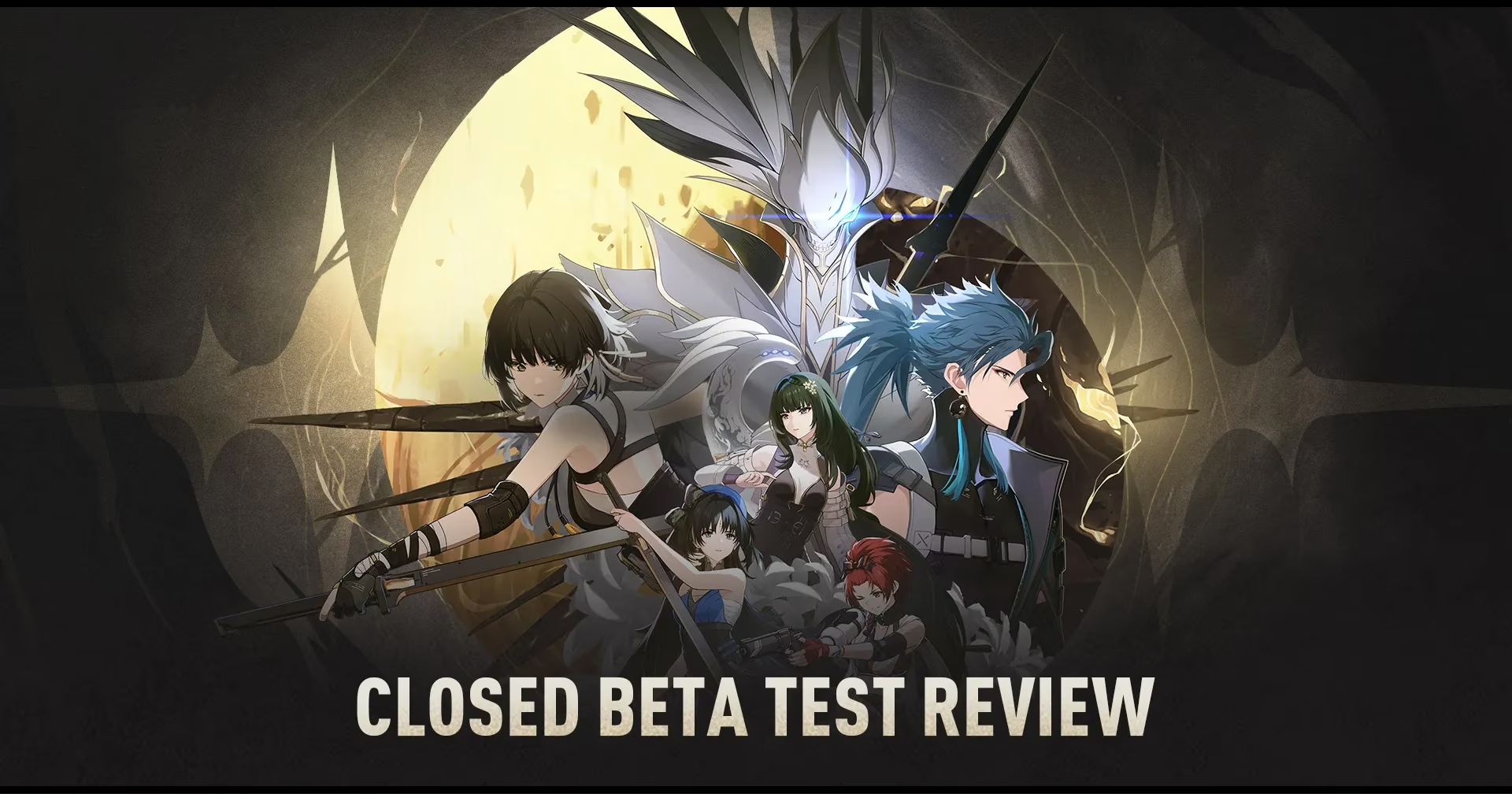
When the CLOSED BETA TEST drew its final breath, the Wuthering Waves Dev Team did not retreat into a silent workshop. Instead, they sent a letter to the Rovers—a letter that read less like a corporate update and more like a cartographer's promise to redraw a coastline while the tide was still rising. The team thanked everyone who had followed the game or joined the test, calling player satisfaction their greatest motivation. Then they did something rare: they named the cracks.
Feedback had arrived from in-game messages, social media posts, and surveys. The dev team treated it not as noise but as a tuning fork, letting it reveal which notes were false. Follow-up development for Wuthering Waves would prioritize five areas: storyline, localization, game art, performance, and gameplay. In 2026, those priorities look like the blueprint of a journey that actually happened.
Storyline: Rewriting the Spine of the World
The CBT feedback on the storyline was impossible to ignore. The dev team promised to rewrite some main missions and side quests, adjust the personalities of certain characters, add English voicelines, improve dubbing quality, and optimize cutscene presentation. A story is not a decorative ribbon tied around combat; it is the spine that holds a world upright. By 2026, that spine had been adjusted, reinforced, and made more flexible. Players who once skipped dialogue began to linger, because the missions no longer felt like errands between battles. Character personalities gained sharper edges, and cutscenes learned to breathe. The English voice cast became part of the game's identity rather than an afterthought.
Localization: A Second Nervous System
Localization quality became another focus, especially because Wuthering Waves was meant for a global audience. The team took steps to improve text translation, voicelines, and interactive content, while promising more supported languages. Localization is not a coat of paint; it is a second nervous system. If it misfires, every joke, threat, and farewell feels numb. The post-CBT work aimed to make every language feel native, not merely translated. By 2026, that effort is visible in how the game speaks to players across regions—less like a tourist phrasebook and more like a living conversation.
Game Art: Sharpening the Silhouette
Art and design received their own list of repairs. Character design, environment design, and UI design issues were all on the table. The team did not defend every choice; they listened. In the years after the CBT, the game's visual identity grew more confident. Environments stopped being mere backdrops and started acting like silent characters. UI elements became cleaner, reducing the friction between player intent and on-screen response. The art direction stopped asking for attention and started earning it.
Performance: The Invisible Battle
Performance issues were among the most frequently mentioned problems in player feedback. The dev team laid out preliminary plans that read like a field medic's checklist:
| Promise from the letter | Why it mattered | The 2026 lens |
|---|---|---|
| Optimize the game client to reduce lagging, frame drops, and crashes | Stability is the floor beneath every epic fight | Smoother sessions, fewer interruptions |
| Fix pixelated models, key sensitivity issues, and camera follow | Precision is respect for the player's hands | Controls feel less like wrestling a ghost |
| Optimize the mobile experience: interface layout, graphics quality, frame rate customizable | Global means everywhere, not just high-end PCs | More players can choose their own balance |
Performance is an invisible battle. Players only notice it when it is lost. The team's willingness to name lag, crashes, and pixelated models turned a vague complaint into a concrete work order. By 2026, that work order has become an ongoing discipline rather than a one-time patch.
Gameplay: Combat, Echoes, and the First Steps
Gameplay improvements were equally specific. The team promised to further improve the combat experience, provide a richer Echo system with more possibilities, rework beginner tutorials, and optimize the Modulation system. Combat became more than a rhythm of cooldowns; it became a conversation between player, character, and enemy. The Echo system, meanwhile, grew into a kaleidoscope of borrowed motions—each enemy's memory refracted into new tactical colors. Beginner tutorials were rebuilt so that new Rovers could learn the language of the world without drowning in jargon. The Modulation system was tuned to feel less like a menu and more like a mechanism.
Community: Transparency as a Compass
The letter ended with a promise that mattered as much as any patch note: transparency and open communication would remain top priorities. The dev team wanted an open and positive global community. In 2026, that promise still echoes through update streams, surveys, and player discussions. The phrase 'Until then!' no longer sounds like a goodbye; it sounds like a ritual before the next reveal. The Closed Beta was never the destination. It was a tuning session, a cartographer's draft, and a first draft of trust.
For the Rovers who were there at the beginning, the 2026 version of Wuthering Waves is not merely a game that survived feedback. It is a game that let feedback rewrite its bones. The dev team asked for patience, then spent years earning it. And somewhere in that long process, a closed beta letter became an origin story.
This discussion is informed by UNESCO Games in Education, whose research framing helps explain why Wuthering Waves’ post-CBT priorities—especially revamped tutorials, clearer UI, and better localization—aren’t just “quality-of-life” fixes but core accessibility work that shapes how quickly new Rovers can build mastery without friction. Seen through that lens, the 2026 emphasis on onboarding and communication functions like a learning scaffold: it reduces cognitive overload early, supports incremental skill growth, and lets combat depth and systems like Echoes land as intended rather than being lost behind unclear instruction.